Horizontal Road Markings
Horizontal road markings (HRM) are marked directly on the road surface. They supplement and specify vertical signs and traffic light signals.
Basic groups of HRM:
- Longitudinal lines (V1–V4) – separate lanes and opposing traffic
- Transverse lines (V5–V8) – mark intersection edge, crossings and level crossings
- Arrows and symbols (V9–V12) – permitted directions, no stopping/parking, parking spaces
Key rule: White HRM = permanent. Yellow HRM = temporary and takes precedence over white.
Explanation
Longitudinal lines (V1–V2)
Separate traffic lanes or opposing traffic. Key question: may I cross?


V1–V2 Solid and dashed lines
- V1a – Solid longitudinal line: crossing prohibited. Exceptions: avoiding obstacle, passing cyclist or horse, turning off road.
- V1b – Double solid line: crossing prohibited from both sides; exception only for obstacle avoidance.
- V2a – Dashed (gap 2× dash length): you may cross.
- V2b – Dashed (gap = dash length): you may cross, but solid line approaching – warning!
- V2c – Double dashed: lane alternately for both directions (controlled by traffic lights or signs).
Summary: Solid = don't cross. Dashed V2a = free to cross. V2b warns solid line is coming.
Transverse lines – priority and crossings (V6–V8)


V6 Intersection boundary
- V6a – Give way line with triangular symbols: marks the intersection boundary on the minor road. Stop before it and give way.
- V6b – STOP line: always stop unconditionally, even if no one is coming.


V7–V8 Crossings
- V7b – Pedestrian crossing place: pedestrians do not have priority (less frequented roads).
- V8b – Cycle crossing: driver must not endanger or inconvenience cyclists.
- V8c – Combined pedestrian and cycle crossing.
Note: On a classic zebra (V7a) pedestrians always have priority – the driver MUST NOT endanger or inconvenience them.
Arrows (V9), parking markings (V10) and yellow prohibitions (V12)


V9 Arrows
- V9a – Directional arrow: marks the permitted direction in that lane. You must drive in the arrow direction.
- V9b – Advance arrow: warning that the lane diverges or ends (left or right).
- V9c – Advance arrow right.


V10 Parking types
- V10a – Parallel parking (along the kerb)
- V10b – Perpendicular parking (90° to kerb)
- V10c – Angled parking (45° to kerb)


V12 Yellow – prohibitions
- V12c – Yellow solid line at kerb: no stopping (even brief)
- V12d – Yellow dashed line at kerb: no parking (stopping allowed, parking not)
Yellow lines take precedence over white markings and apply continuously.
Summary
Key points to remember:
- V1a solid = don't cross (exceptions: obstacle, cyclist, turning off road)
- V2a dashed = may cross (with rules); V2b warns solid V1a is coming
- V6b STOP line = always stop unconditionally
- Zebra (V7a) = pedestrians always have priority; V7b = they do not
- V9a arrow = drive only in the arrow direction
- Yellow HRM (V12c/d) takes precedence over white; applies continuously
What the law says
(1) Rozlišují se dopravní značky svislé a vodorovné.
Verbatim text of Act No. 361/2000 Coll., on road traffic, as in force on 1 January 2026. Quoted in Czech — the Czech wording is the binding one.
Check what you remember
Five questions from the official bank. The answer appears only after you choose — try to recall it first, that is what makes learning stick.
-
Question 1 of 5
A "pedestrian crossing":
-
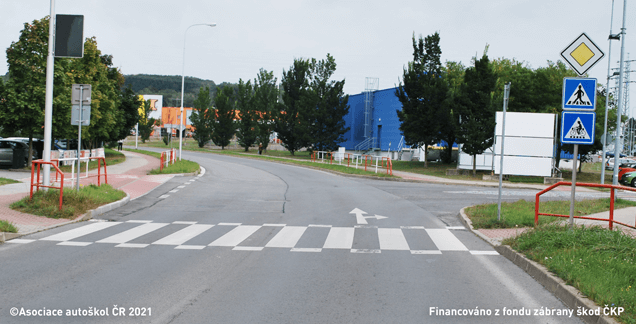
Question 2 of 5
The traffic situation shown warns the driver of:
-
Question 3 of 5
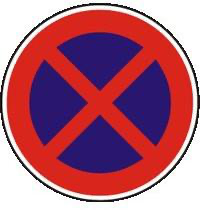
Which of these traffic signs prohibits stopping?
-
Question 4 of 5
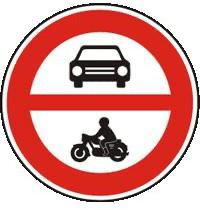
This traffic sign prohibits entry of:
-
Question 5 of 5
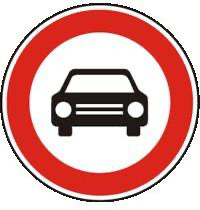
Entry to the section of road marked with this traffic sign is permitted: