Jak je provoz řízen
In traffic, various things can "direct" you: a police officer, a traffic light, traffic signs, and general rules. However, they may sometimes contradict each other. Example: the traffic light is green, but the police officer is signaling "Stop!". What applies? Section 76 of Act 361/2000 Coll. establishes a clear hierarchy - the order in which the rules apply.
Explanation
HIERARCHY OF TRAFFIC CONTROL (from highest priority): 1. POLICE OFFICER'S INSTRUCTIONS (or other authorized persons) - Has absolute priority over everything else - If the police officer is directing traffic, you follow ONLY their instructions - You ignore traffic lights and signs 2. TRAFFIC LIGHTS - Have priority over traffic signs - When the traffic light is functioning, you follow it (not the signs) 3. Temporary Traffic Signs (orange/yellow) - Construction lanes, detours, temporary restrictions - Have priority over permanent signs 4. Permanent Traffic Signs - Common signs that you know (stop, yield, restrictions) 5. General ROAD TRAFFIC RULES - Yield to the right, max speed in town 50 km/h, etc. - Apply when nothing else is present
Example
Practical example - intersection with construction: At the intersection, you see: - A permanent sign warning of 'Yield to the right' - A temporary sign 'Main road' - A traffic light (but it is off) - A police officer directing traffic What do you follow? ONLY the police officer's instructions! You ignore the signs and the traffic light. Another example - traffic light + STOP: - At the intersection, there is a STOP sign and a traffic light - The traffic light is GREEN - What do you follow? THE TRAFFIC LIGHT - you go on green, you ignore the STOP sign - But when the traffic light is OFF (it is off)? Then the STOP sign applies - you stop and yield.
Explanation
POLICE OFFICER'S INSTRUCTIONS - how to understand them: A police officer can direct traffic with their hands or a baton. Basic signals: - FACING or TURNED AWAY from you = STOP (red) - SIDEWAYS to you = GO in the direction of their arms (green) - RAISED HAND = ATTENTION, transition to a new signal (yellow) Other authorized persons whose instructions you must obey: - Military police - Customs administration - Municipal police (officers) - Persons with an orange vest and stop sign (e.g., at a construction site) Note: Not everyone who stands on the road can direct traffic. You must recognize whether they are an authorized person.
Common mistakes
Typical mistakes during the exam: 1. "When there is a traffic light, signs do not apply" - PARTIALLY true, but only when the traffic light is on. An off traffic light = you follow the signs. 2. "Temporary signs do not have greater weight" - Incorrect. Temporary signs have priority over permanent ones. 3. "When a police officer directs traffic, I follow the traffic light" - Incorrect! The police officer has absolute priority. 4. "An officer cannot order me to stop" - Incorrect. The municipal police (officer) is an authorized person.
How to remember it
Practical summary: Hierarchy of traffic control in practice – who commands: 1. Police officer at the intersection → their instructions have absolute priority, even if the traffic light shows green 2. Traffic light → has priority over traffic signs 3. Temporary signs → have priority over permanent signs 4. Permanent traffic signs → apply when there is neither a traffic light nor a police officer 5. General rules (yield to the right) → apply when nothing else determines priority The most common mistake in practice: A driver follows the main road sign but overlooks the police officer's instruction to stop. The police officer ALWAYS has priority. Another common mistake: At the intersection, there are temporary signs (e.g., due to a closure) and also permanent signs. The temporary ones apply.
Explanation
Road Traffic Rules Intersections - police POlice Traffic control by a police officer is the highest authority in the hierarchy of traffic rules. Any instructions given by a police officer while directing or regulating traffic override: • temporary traffic regulation (portable signs), • local traffic regulation (traffic lights and vertical road signs), • general traffic rules (e.g. priority from the right). A police officer controls traffic mainly by body position and arm signals, usually using a traffic stick in the right hand. Basic Positions and Signals “STOP” • The police officer is facing you or has their back to you. • The driver must stop before the intersection boundary. “ATTENTION / PREPARE” • The officer raises an arm or forearm (with stick). • Meaning: ◦ for drivers who were stopped → prepare to move, ◦ for drivers who previously had free passage → prepare to stop, unless stopping safely is no longer possible. “GO” • The police officer is standing sideways to the driver. • The driver may: ◦ go straight, ◦ turn left or right while following standard turning rules (oncoming vehicles and trams both front and rear priority). Special Position – “Three-Direction Control” If the police officer has: • the right arm extended forward, and • the left arm extended sideways, the signals have different meanings depending on approach direction: • STOP Applies to drivers approaching: • the officer’s back, • the officer’s right side. • GO Applies to drivers approaching the left side of the officer. They may go straight or turn left or right. • Right Turn Allowed Drivers approaching the front of the officer may turn right. Pedestrians may cross the road only behind the officer’s back. Additional Hand Signals The police officer may also give extra signals to regulate traffic flow: • “Speed up!” – horizontal waving of the arm across the body. • “Slow down!” – vertical up-and-down arm movement. • Whistle – used to emphasise or draw attention to instructions. Other Persons Authorized to Control or Regulate Traffic Under specific legal conditions, traffic may also be directed or regulated by: • military police • municipal police officers - only regulating, • customs officers - only regulating, • firefighters - only regulating
Road Traffic Rules Intersections - police "Stop!" for drivers coming towards the front or back of the officer. „Stop!" for drivers coming towards the officer's back and right side. "Free!" 1.
Summary
Remember the hierarchy: 1. Police officer (person) - absolute priority 2. Traffic light (machine) - when lit, applies instead of signs 3. Temporary signs - override permanent ones 4. Permanent signs - common traffic signage 5. General rules - yield to the right, speed limits An off traffic light = you follow the signs. No signs = general rules. Legal basis: Section 76 of Act 361/2000 Coll.
What the law says
(1) Místní úprava provozu na pozemních komunikacích je nadřazená obecné úpravě provozu na pozemních komunikacích. Přechodná úprava provozu na pozemních komunikacích je nadřazena místní i obecné úpravě provozu na pozemních komunikacích.
(1) Policista řídí provoz na pozemních komunikacích změnou postoje a pokyny paží; přitom zpravidla používá směrovku, kterou drží v pravé ruce. Jeho pokyny znamenají pro řidiče i chodce
a) "Stůj!" pro směr, ke kterému stojí policista čelem nebo zády; řidič je povinen zastavit vozidlo,
b) "Pozor!", vztyčí-li policista paži nebo předloktí pravé paže se směrovkou; řidič jedoucí ze směru, pro který byl provoz předtím zastaven, je povinen se připravit k jízdě; řidič jedoucí ve směru předtím volném je povinen zastavit vozidlo; je-li však již tak blízko, že by nemohl bezpečně zastavit vozidlo, smí pokračovat v jízdě,
c) "Volno" pro směr, ke kterému stojí policista bokem; řidič může pokračovat v jízdě, a dodrží-li ustanovení o odbočování, může odbočit vpravo nebo vlevo,
d) má-li policista pravou paži předpaženou a levou upaženou, znamená to "Stůj!" pro řidiče přijíždějícího směrem k zádům a pravému boku policisty a "Volno" pro řidiče přijíždějícího směrem k levému boku policisty; řidič přijíždějící směrem k zádům a pravému boku policisty je povinen zastavit vozidlo; řidič přijíždějící k levému boku policisty může pokračovat v jízdě, a dodrží-li ustanovení o odbočování, může odbočit vpravo nebo vlevo; řidič přijíždějící směrem k čelu policisty smí odbočovat jen vpravo; chodci smějí přecházet vozovku jen za zády policisty.
Verbatim text of Act No. 361/2000 Coll., on road traffic, as in force on 1 January 2026. Quoted in Czech — the Czech wording is the binding one.
Check what you remember
Five questions from the official bank. The answer appears only after you choose — try to recall it first, that is what makes learning stick.
-
Question 1 of 5
Local traffic regulation on roads:
§ 76
-
Question 2 of 5
Traffic lights:
§ 76
-
Question 3 of 5
Permanent vertical traffic signs take precedence over:
§ 76
-
Question 4 of 5
The driver of the vehicle shown intends to continue driving to the left. In doing so:
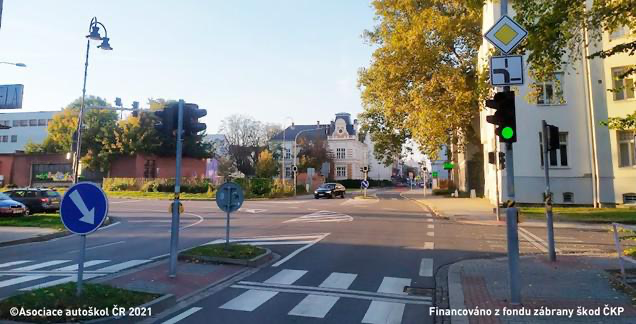
§ 76
-
Question 5 of 5
The driver of the vehicle shown at the depicted junction with an intermittent amber light intends to continue driving to the left. In doing so:
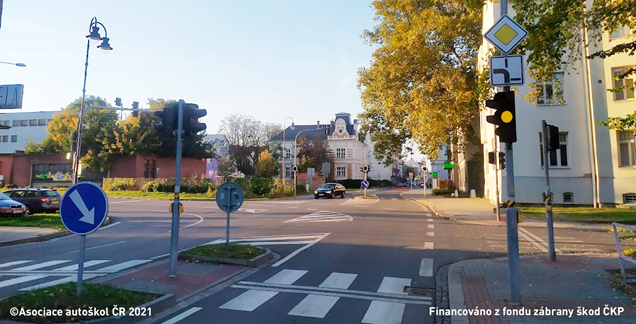
§ 76

