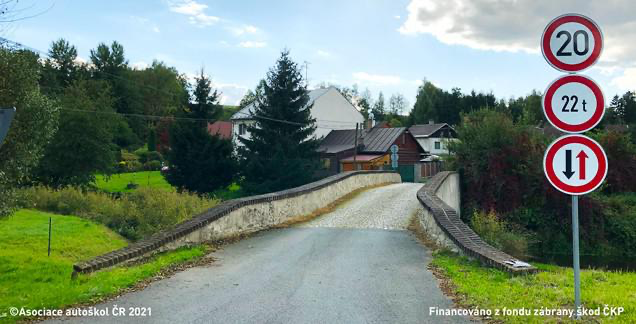
Speed Limits and Regulations
Speed is one of the most important safety factors. The law sets general limits; local signs may raise or lower them; temporary signs always take precedence.
General speed limits (law)
| Zone | Cars, emergency services, buses | Other motor vehicles over 3.5 t |
|---|---|---|
| Built-up area | 50 km/h | 50 km/h |
| Motorway inside built-up area | 80 km/h | 80 km/h |
| Outside built-up area (standard road) | 90 km/h | 80 km/h |
| Motorway outside built-up area | 130 km/h | 80 km/h |
| Highway outside built-up area | 110 km/h | 80 km/h |
Special situations
| Situation | Max speed |
|---|---|
| Railway crossing (normal operation) | 30 km/h within 50 m |
| Railway crossing (flashing white light) | 50 km/h within 50 m |
| Towing another vehicle | 60 km/h |
| Snow chains | 50 km/h |
| Personal transporter (Segway etc.) on paths | Speed of walking |
Explanation
Adapting speed
Regardless of limits, always adjust speed to:
- Your own ability
- Vehicle characteristics and weight
- Road condition and type
- Category of road
- Weather and visibility
- Other foreseeable circumstances
Key rule: The stopping distance must not exceed the visibility distance.
Local speed regulation (permanent signs)
Local signs override general regulation. A speed limit sign is valid from the sign to the nearest intersection, unless ended earlier by:
- Corresponding "End of speed limit" sign
- New speed limit sign
- Entering/leaving a built-up area, motorway, or highway
Zone signs (speed zone, residential zone, pedestrian zone) apply to the entire area until the "End of Zone" sign.
| Zone | Speed |
|---|---|
| Residential zone | 20 km/h |
| Pedestrian zone | 20 km/h |
| Cycle path | 30 km/h |
| Footpath | Walking speed |
Temporary regulation (roadworks, accidents)
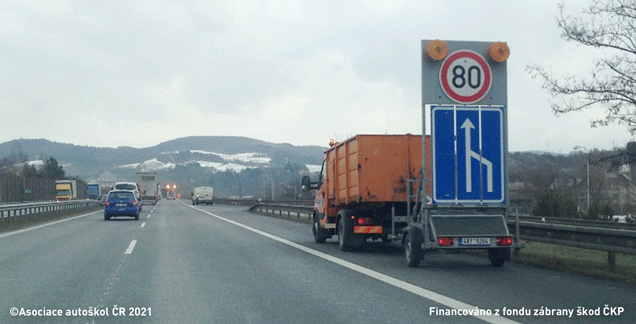
Portable signs on red-and-white striped stands. Valid from sign to nearest intersection or end sign. Mobile worksite: limit applies 100 m behind the working vehicle.
Summary
- In built-up area: 50 km/h
- Outside built-up area: 90 km/h (cars) / 80 km/h (>3.5 t)
- Motorway: 130 km/h (cars) / 80 km/h (>3.5 t)
- Always adapt to conditions – must stop within distance visible
- Temporary sign > permanent sign > general law
What the law says
(3) Řidič motorového vozidla o maximální přípustné hmotnosti nepřevyšující 3 500 kg, vozidla základní složky integrovaného záchranného systému a autobusu smí jet mimo obec rychlostí nejvýše 90 km.h-1; na silnici pro motorová vozidla rychlostí nejvýše 110 km.h-1 a na dálnici rychlostí nejvýše 130 km.h-1. Řidič jiného motorového vozidla smí jet rychlostí nejvýše 80 km.h-1.
(4) V obci smí jet řidič rychlostí nejvýše 50 km.h-1, a jde-li o dálnici nebo silnici pro motorová vozidla, nejvýše 80 km.h-1.
(6) Místní úpravou provozu na pozemních komunikacích podle § 61 odst. 2 lze nejvyšší dovolenou rychlost podle odstavců 3 a 4 snížit. Jde-li o dálnici nebo silnici pro motorová vozidla bez směrově oddělených jízdních pásů, sníží se nejvyšší dovolená rychlost na nejvýše 90 km.h-1.
Verbatim text of Act No. 361/2000 Coll., on road traffic, as in force on 1 January 2026. Quoted in Czech — the Czech wording is the binding one.
Check what you remember
Five questions from the official bank. The answer appears only after you choose — try to recall it first, that is what makes learning stick.
-
Question 1 of 5
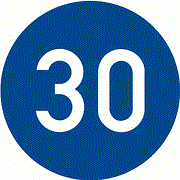
Which of the traffic signs shown prohibits the driver from travelling at 40 km/h:
-
Question 2 of 5
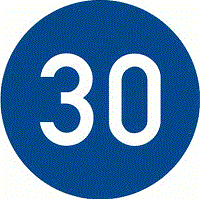
Select the traffic sign "Minimum speed limit" which instructs the driver, if other traffic conditions permit, to drive at least at the speed shown on the sign in kilometres per hour.
-
Question 3 of 5
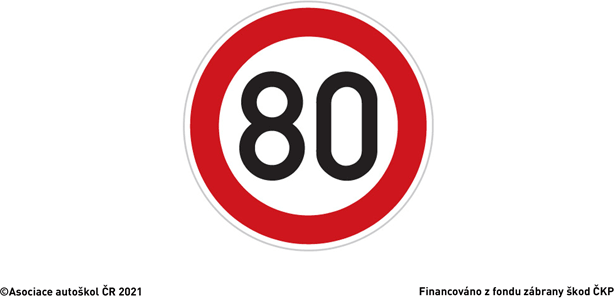
How may the validity of the vertical traffic sign "Maximum Speed" be ended?
-
Question 4 of 5
The validity of the portable traffic sign "Maximum Speed" placed on a vehicle marking a mobile work zone formed by a slowly moving vehicle or group of vehicles ends:
-
Question 5 of 5
The car driver from the view in the traffic situation shown: