Turning
Turning is one of the most common and riskiest maneuvers in traffic. Section 21 of Act 361/2000 Coll. establishes the rules for turning left and right. Poor turning is among the frequent causes of accidents.
When turning, think mainly about 4 things:
- correct lane positioning,
- timely signaling,
- checking for pedestrians and cyclists,
- oncoming vehicles and trams from behind
Explanation
Turning RIGHT (Section 21)
When turning right: 1. Position yourself in the right lane (as close to the right edge as possible) 2. Activate the RIGHT turn signal well in advance 3. Slow down and look around 4. Yield to pedestrians at the crosswalk you are turning into 5. Yield to cyclists in the bike lane on your right side 6. Turn smoothly
Important: Even if you are on a main road and turning right, you must yield to pedestrians at the crosswalk beyond the intersection!
Cyclist in the bike lane: Watch out for cyclists on your right side. When turning right, you may cross the bike lane - the cyclist has the right of way!
Turning LEFT (Section 21)
Turning left is more complex and dangerous:
1. Position yourself in the left lane (or towards the center of the road on a two-lane road) 2. Activate the LEFT turn signal 3. YIELD to oncoming vehicles and trams in both directions, and to any buses in the reserved lane 4. YIELD to pedestrians at the crosswalk 5. If two drivers are turning left against each other at the intersection, they pass each other on the LEFT (i.e., each turns in front of the other)
Important: When turning left at an intersection with a main road, you always yield to oncoming traffic, even if both of you are on the main road!
At a traffic light (green arrow left): you can turn without yielding to oncoming traffic, as they have a red light.
Example
Example - turning left at an intersection:
You are driving on the main road and want to turn left. A car is coming straight towards you.
1. You must wait for the oncoming car to pass 2. Then check for pedestrians at the crosswalk 3. Only when it is clear, you turn
Example - two drivers turning left against each other: You and the oncoming car both want to turn left. Generally, you pass each other on the right (in front of you), if the layout of the intersection allows it. This way, both of you can turn smoothly, without unnecessary waiting.
Exception: If the layout of the intersection does not allow it (small intersection), it is better to wait until the intersection space is clear.
Common mistakes
Common mistakes:
1. "When I am on the main road, I do not have to yield to oncoming traffic when turning left" - Incorrect! When turning left, you yield to oncoming traffic.
2. "Pedestrians at the crosswalk must wait until I turn" - Incorrect! You yield to pedestrians.
3. "When turning right, I do not have to check for cyclists" - Incorrect! A cyclist in the bike lane has the right of way.
4. "I will turn on the turn signal just before turning" - Incorrect! Activate the turn signal well in advance so that others know what you intend to do.
Explanation
Road Traffic Rules Intersections - turning left Turning Left – Rules and Requirements The rules for turning left cover the driver’s main responsibilities, road positioning, yielding (priority) rules, and the relevant traffic signs and signals. I. Driver’s Duties When Turning Left General Obligation: When turning at an intersection or into a place off the road, the driver must signal the change of direction and drive with extra caution. Road Positioning: Before turning left, position the vehicle as close as possible to the left edge of the lane for your direction of travel !!! 2-way vs 1-way street !!!. Adjust this according to your vehicle’s size, load, and the road’s width. When two vehicles from opposite directions are both turning left, they pass in front of each other (left side to left side). Signaling: Signal the turn in time before starting the maneuver, taking into account the traffic around you, especially vehicles behind. Use the turn indicators if available. If your indicators are not working, signal by hand: • Turning left: extend your left arm horizontally. • Turning right: extend your left arm upward at a 90° angle. Turning Rules: When turning left, the driver must yield (give way) to: 1. Oncoming vehicles – both motorized and non-motorized. 2. Riders on animals coming from the opposite direction. 3. Oncoming groups of pedestrians and people guiding animals. 4. Trams coming from both directions. 5. Vehicles traveling in a designated lane (e.g. bus or taxi lane). 6. Cyclists traveling in a cycle lane. When turning, the driver must also not endanger pedestrians crossing the road they are turning onto. II. Traffic Signs and Signals Related to Turning Left 1. Mandatory Signs These signs order the driver to turn left or specify directions of travel: • C 2c: Mandatory direction – left only. • C 2e: Mandatory direction – straight or left. • C 2f: Mandatory direction – right or left. • C 3b: Turn left immediately before the sign. • C 4b: Pass the obstacle on the left. • C 4c: Pass the obstacle either on the right or on the left. 2. Warning Signs These warn of upcoming curves to the left: • A 1b: Curve to the left – reduce speed. • A 2b: Double curve – first to the left – reduce speed. 3. Road Markings Directional arrows (V 9a) show how traffic is divided into lanes before an intersection or turning point and indicate the allowed directions (including turning left). 4.
How to remember it
Practical summary:
Turning – checklist:
Turning RIGHT: 1. Turn signal to the right (in advance) 2. Position yourself as far right as possible 3. Check the rearview mirror and blind spot (cyclist!) 4. Yield to pedestrians at the crosswalk 5. Yield to cyclists in the bike lane
Turning LEFT: 1. Turn signal to the left (in advance) 2. Position yourself as far towards the center of the road as possible 3. Yield to oncoming vehicles and trams from behind 4. Yield to pedestrians at the crosswalk
Most common mistake: A driver turning right overlooks a cyclist riding along the right side. Always check the right blind spot!
What the law says
(1) Při odbočování na křižovatce nebo na místo ležící mimo pozemní komunikaci musí řidič dávat znamení o změně směru jízdy; při odbočování nesmí ohrozit řidiče jedoucí za ním a musí dbát zvýšené opatrnosti.
(5) Řidič odbočující vlevo musí dát přednost v jízdě protijedoucím motorovým i nemotorovým vozidlům, jezdcům na zvířeti, protijdoucím organizovaným útvarům chodců a průvodcům hnaných zvířat se zvířaty, tramvajím jedoucím v obou směrech a vozidlům jedoucím ve vyhrazeném jízdním pruhu, pro něž je tento jízdní pruh vyhrazen, a cyklistům jedoucím v jízdním pruhu pro cyklisty.
Verbatim text of Act No. 361/2000 Coll., on road traffic, as in force on 1 January 2026. Quoted in Czech — the Czech wording is the binding one.
Check what you remember
Five questions from the official bank. The answer appears only after you choose — try to recall it first, that is what makes learning stick.
-
Question 1 of 5
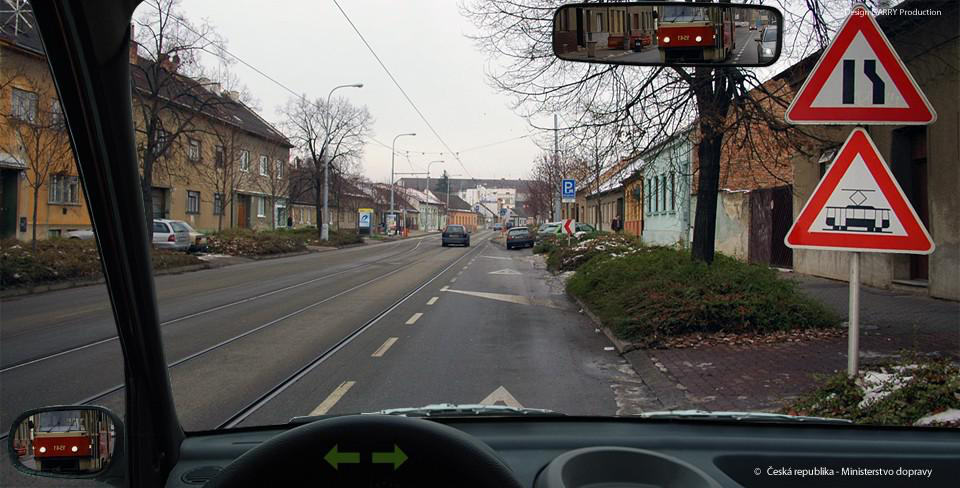
May you impede a tram when entering the tram track?
-
Question 2 of 5
By switching on the hazard warning lights, the driver gives a warning when:
-
Question 3 of 5
Behind a public transport vehicle that has stopped in a built-up area at a stop without a boarding island or platform on a raised tram track, the driver of another vehicle must:
-
Question 4 of 5
The driver must not exceed:
-
Question 5 of 5
A driver who does not intend to or cannot pass along the right side of a tram:
