Highway: Entry and Exit
Driving on the highway and roads for motor vehicles has specific rules. Sections 35-38 of Act 361/2000 Coll. regulate entry onto the highway, driving on it, and exit.
The highway is the safest type of road, but only if everyone follows the rules - especially safe distances between vehicles.
Explanation
ENTRY ONTO THE HIGHWAY (Section 36):
You enter the highway via the ACCELERATION LANE:
1. Accelerate in the acceleration lane to the speed of traffic on the highway 2. Turn on your LEFT turn signal 3. Check your mirror and blind spot 4. Smoothly merge into the right lane 5. A driver on the highway should allow merging, but is NOT obliged to yield
IMPORTANT: As the merging driver, YOU MUST NOT endanger drivers on the highway. You must adjust your speed and find a gap.
Minimum speed on the highway: 80 km/h. A vehicle that cannot reach 80 km/h is NOT allowed on the highway.
DRIVING ON THE HIGHWAY:
- Drive in the RIGHT lane, the left lane is only for overtaking
- Max speed: 130 km/h (may be increased to 150 km/h by sign)
- Trucks over 3.5 t: max. 80 km/h
- On the highway, it is NOT allowed to:
- Stop (except for emergency stops)
- Reverse
- Turn around
- Drive in the emergency lane (only for breakdowns)
EMERGENCY LANE:
- It is NOT a driving lane!
- It is only for broken down and crashed vehicles
- When stopped in the emergency lane: turn on hazard lights + wear a reflective vest + place a warning triangle 100 m behind the vehicle
EXIT FROM THE HIGHWAY:
- Move into the DECELERATION LANE
- Slow down only in this lane, NOT in the driving lane!
Example
Example - merging onto the highway:
You are driving on the acceleration lane. A truck is driving in the right lane at 80 km/h.
1. Accelerate to at least 80 km/h (ideally more) 2. Turn on your left turn signal 3. Look in the mirror - the truck is far away 4. Check the blind spot over your left shoulder 5. Smoothly merge in front of the truck with sufficient distance
WHAT YOU SHOULD NOT DO:
- Do not stop at the end of the acceleration lane (dangerous!)
- Do not merge directly in front of the truck (you would endanger it)
- Do not drive in the emergency lane
Common mistakes
Common mistakes:
1. "Drivers on the highway must yield to me" - NO! You must adapt to the traffic on the highway.
2. "I can drive in the emergency lane when traffic is heavy" - NO! The emergency lane is not a driving lane.
3. "I brake in the driving lane before the exit" - NO! Slow down only in the deceleration lane.
4. "I can stop on the highway and look at the map" - NO! You must not stop on the highway (only in emergencies).
How to remember it
Practical summary:
Highway – what you need to know:
Merging onto the highway: 1. In the acceleration lane, accelerate to the speed of traffic 2. Left turn signal, check the blind spot 3. Smoothly merge – YOU MUST NOT endanger traffic on the highway 4. If you cannot merge, slow down at the end of the acceleration lane and wait for a gap
Driving on the highway:
- Basic rule: Drive RIGHT. The left lane is only for overtaking.
- Max speed: 130 km/h (min construction speed of the vehicle: 80 km/h)
- Rescue lane: Left lane LEFT, others RIGHT – create immediately
It is PROHIBITED on the highway: to stop, reverse, turn around, walk, or ride a bicycle.
What the law says
r) dálnice je pozemní komunikace označená dopravní značkou "Dálnice",
u) připojovací pruh je přídatný jízdní pruh určený pro zařazování vozidel do jízdního proudu průběžného pruhu,
(1) Řidiči je na dálnici zakázáno
a) zastavení a stání jinde než na místech označených jako parkoviště. Při nouzovém stání podle § 26 odst. 3 musí vozidlo stát na krajnici, a jen není-li to možné, na vozovce. Takové vozidlo musí řidič vždy označit jako překážku provozu na pozemních komunikacích; jde-li o motorové vozidlo povinně vybavené přenosným výstražným trojúhelníkem,2) musí řidič umístit trojúhelník podle § 26 odst. 3,
b) otáčení, couvání a vjíždění na střední dělicí pás včetně míst, kde je pás přerušen.
Verbatim text of Act No. 361/2000 Coll., on road traffic, as in force on 1 January 2026. Quoted in Czech — the Czech wording is the binding one.
Check what you remember
Five questions from the official bank. The answer appears only after you choose — try to recall it first, that is what makes learning stick.
-
Question 1 of 5
A customs officer in uniform:
-
Question 2 of 5
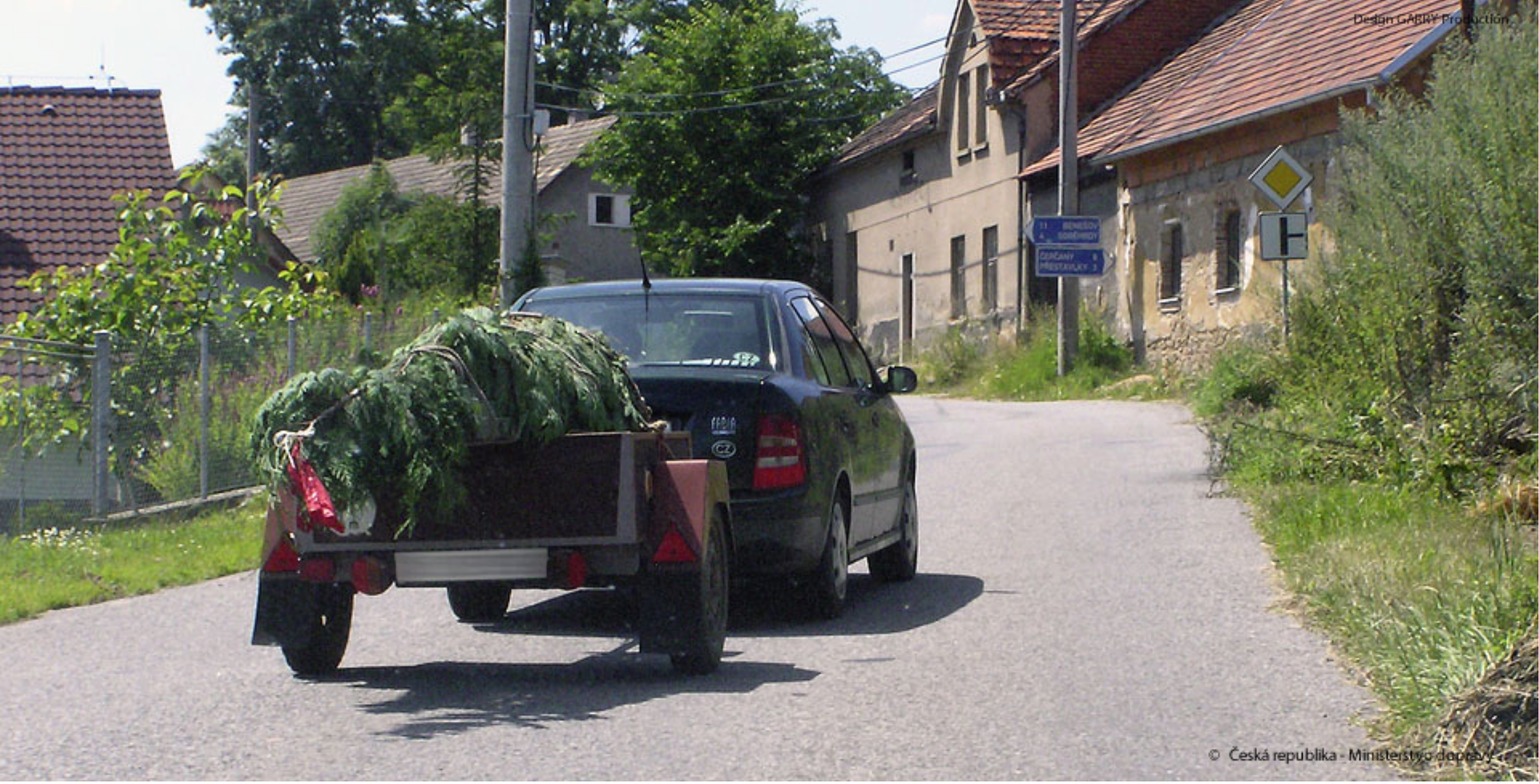
If a load projects more than 1 metre beyond the front or rear of a vehicle in reduced visibility conditions, the projecting end of the load must be:
-
Question 3 of 5
If a load projects more than 1 metre beyond the front or rear of a vehicle in normal visibility conditions, the projecting end of the load must be:
-
Question 4 of 5
If in normal visibility conditions a load projects more than 40 cm beyond the outer edge of the side marker lights of a motor vehicle or a combination of vehicles, the projecting end of the load must be:
-
Question 5 of 5
If in reduced visibility conditions a load projects more than 40 cm beyond the outer edge of the side marker lights of a motor vehicle or a combination of vehicles, the projecting end of the load must be:
