Turning Left: Rules & Examples
Turning left is one of the more complex manoeuvres – the driver must signal correctly, position the vehicle, and give way.
Duties when turning left:
1. Signal – indicate in time relative to traffic behind you 2. Position – move as close as possible to the left edge of your lane (two-way road) or left edge of the road (one-way) 3. Give way to oncoming traffic, trams from both directions, cyclists and pedestrians 4. When two vehicles from opposite directions both turn left: pass each other on the left (left side to left side)
Hand signals if indicators not working:
- Turning left: extend left arm horizontally
- Turning right: extend left arm upward at 90°
Explanation
When turning left, give way to:
| Road user | Give way? |
|---|---|
| Oncoming motor vehicles | ✅ Yes |
| Oncoming non-motor vehicles | ✅ Yes |
| Riders on animals (oncoming) | ✅ Yes |
| Organised pedestrian groups (oncoming) | ✅ Yes |
| Trams in both directions | ✅ Yes |
| Vehicles in reserved lanes (bus, taxi) | ✅ Yes |
| Cyclists in cycle lane | ✅ Yes |
| Pedestrians crossing the road being turned into | ✅ Must not endanger |
Entering and waiting in the intersection
Generally may not enter if you'd have to stop inside. Exception: may wait inside when turning left and giving way to oncoming traffic.
Relevant signs and signals
- C2c: Mandatory direction – left only
- C2e: Mandatory direction – straight or left
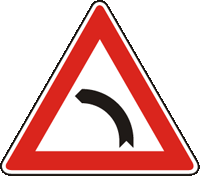
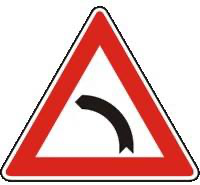
- A1b: Warning – curve to the left ahead
- S2c (green arrow left): May turn left without giving way to oncoming traffic
- S6 (signal for leaving intersection): If visible at opposite corner, no need to yield when turning left
Summary
- Signal in time, position left, give way to oncoming and trams
- Trams: right of way from both directions (including behind you)
- Two vehicles turning left: pass each other on the left
- Green arrow left: no need to give way to oncoming traffic
- Cannot stop inside intersection (exception: waiting for oncoming when turning left)
What the law says
(5) Řidič odbočující vlevo musí dát přednost v jízdě protijedoucím motorovým i nemotorovým vozidlům, jezdcům na zvířeti, protijdoucím organizovaným útvarům chodců a průvodcům hnaných zvířat se zvířaty, tramvajím jedoucím v obou směrech a vozidlům jedoucím ve vyhrazeném jízdním pruhu, pro něž je tento jízdní pruh vyhrazen, a cyklistům jedoucím v jízdním pruhu pro cyklisty.
q) dát přednost v jízdě znamená povinnost řidiče nezahájit jízdu nebo jízdní úkon nebo v nich nepokračovat, jestliže by řidič, který má přednost v jízdě, musel náhle změnit směr nebo rychlost jízdy,
Verbatim text of Act No. 361/2000 Coll., on road traffic, as in force on 1 January 2026. Quoted in Czech — the Czech wording is the binding one.
Check what you remember
Five questions from the official bank. The answer appears only after you choose — try to recall it first, that is what makes learning stick.
-
Question 1 of 5
This traffic sign warns of:
-
Question 2 of 5
What does this traffic sign tell you?
-
Question 3 of 5
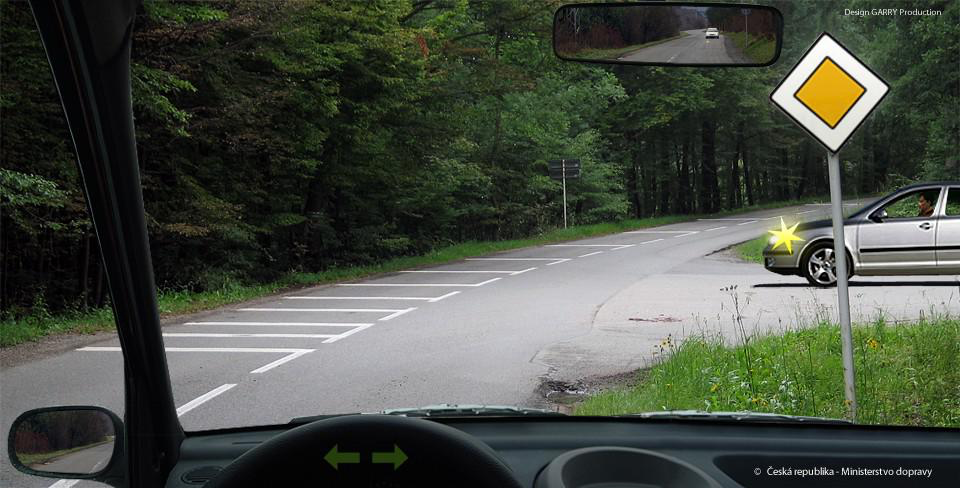
In the depicted situation, you are the driver of the vehicle from the viewpoint. How will you behave?
-
Question 4 of 5
On a dual carriageway:
-
Question 5 of 5
If operational or other serious reasons require that passengers alighting from a public transport vehicle outside a stop or boarding it outside a stop must enter the carriageway:


